
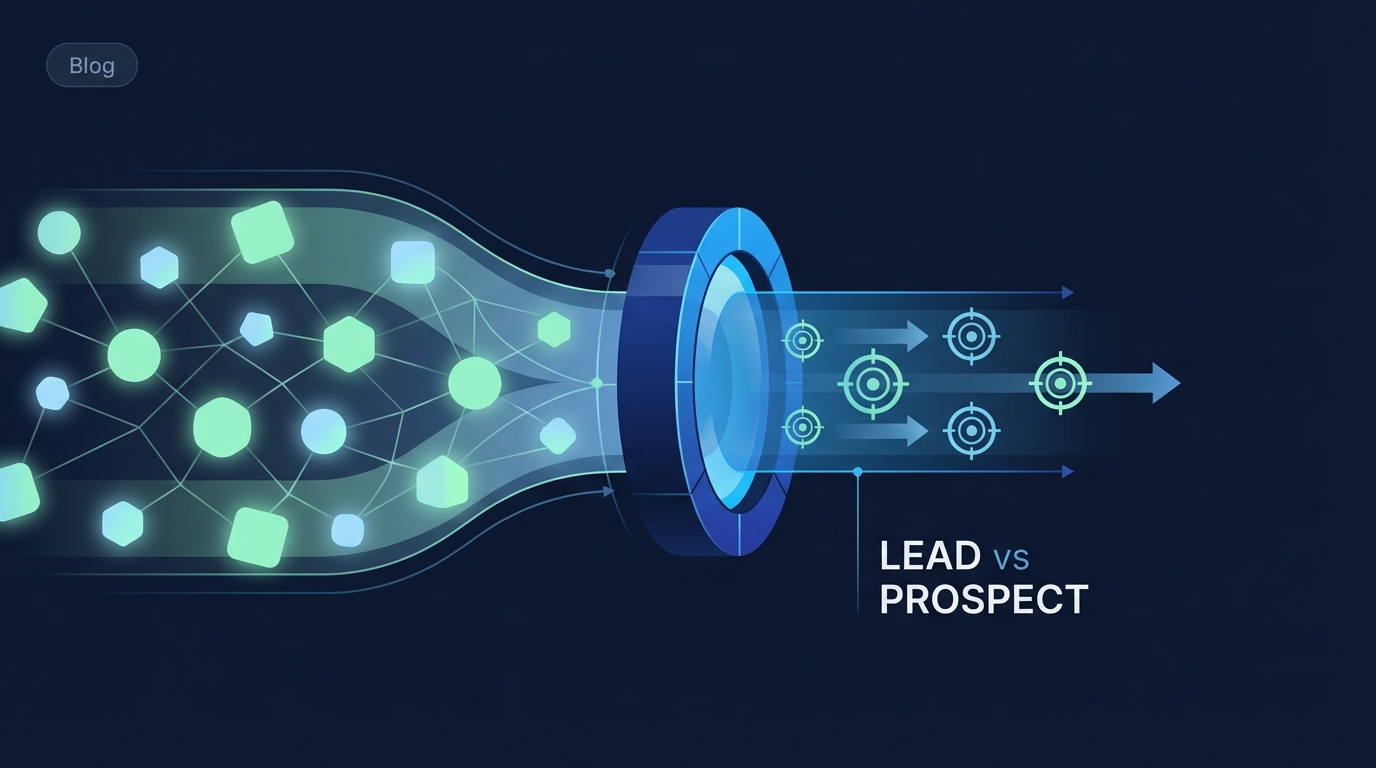
Do you want to grow your business and attract new customers? 🎯 Before launching into prospecting, take the time to understand the difference between lead vs prospect. This will help you develop the best prospecting strategy and adjust your speech. 🗣️
What is a Lead? Definition
Leads are often used in B2B marketing contexts and are a way to acquire new customers. 🤑 This is a contact who has expressed an interest in your business or what you have to offer.
This could be a visitor who has completed an information sheet in-store or at a trade fair, or who has responded to an email after requesting a quote or information. 📧 This is the very first contact you have, so you do not have sufficient information to define the needs of this contact. 🤔
What is a Prospect?
Leads can be defined as qualified contacts. 🤓 This qualification is generally carried out by a salesperson. After analysis, he can determine if this prospect corresponds to the company’s target. 🧲 If this is the case, he will be able to offer the product or service that best meets his expectations and, therefore, choose your business.
One of the main tasks of salespeople in B2B activities is to convert leads into prospects. In other words, it “qualifies” the leads generated by your various marketing efforts. 💪
What is the difference between lead and prospect?
Now that you know what a lead and a prospect are, let’s see what the main differences are. 🔎 Indeed, everything depends on the degree of maturity of the contact.
The customer journey begins with a suspect. 👉 If they are just a visitor to your website, they are barely considered a lead. In fact, at this stage, we do not have the necessary information to contact him and see if the solution meets his needs.
On the other hand, prospects and qualified leads show that they have specific needs and that your company can meet them. 👂 Sellers can conduct a survey and accurately determine whether this target or “buyer persona” meets the defined business objectives.
So, what is the difference between lead vs prospect? 🧐 Leads are learning about your product and are only at the first stage of information gathering. While personas or “qualified leads” will take a more proactive approach. Sellers need to make sure their needs match your company’s services.We call him a “customer” when he is at the home stretch of the sales process. 👏 A customer is someone who is truly convinced to make a purchase. It is important to differentiate between leads and prospects so as not to waste time with people who are curious about your solution, but who do not have a problem to solve with your product or service. 🤷
How to measure the maturity level of your leads and prospects?
To measure the maturity of your contacts, you can implement a commercial strategy of “lead scoring”, which we will see immediately afterwards. 🌟 Measuring the maturity level of your leads and prospects is crucial to optimizing your sales strategy. 🤑 Start by defining specific criteria based on behavior and engagement, such as the number of interactions with your site, subscribing to newsletters or participating in webinars. ☄️
Use lead scoring CRM tools to assign points based on these criteria, allowing leads to be classified from “cold” to “hot”. 🤒 The most mature leads are those who show active and regular interest, indicating that they are closer to making a purchasing decision. 🧠 Adapting your communications plan based on this level of maturity can greatly improve the effectiveness of your sales efforts.
What is Lead Scoring?
Indeed, to optimize conversion rates (converting leads into customers), sales teams can choose how to score leads, i.e. do lead scoring. ⭐ This allows you to assign a rating from 0 to 100, for example. If you give a score of 90, prospects are more likely to seek your services. 👉 However, if the rating is 10, there is little chance of conversion.
In this example, we will qualify the lead from 1 to 4 to determine if it is a hot 🔥 or cold ❄️ lead. To be as precise as possible, you must define internal criteria such as:
-
The function of contact: if you speak directly to the decision-maker during discussions, you have a better chance of making a sale quickly.
-
Budget allocated to this type of project: if you are offered a price significantly lower than what you asked for, you know that you have less chance of them becoming a customer.
-
Lead acquisition channels: depending on the sector, certain channels are more relevant than others, the type of content etc.
Companies that practice lead scoring to develop contacts throughout the purchasing process have a greater chance of obtaining new customers. 🚀
How to transform a lead into a prospect?Turning prospects into customers is an important sales cycle that requires a clearly defined prospecting strategy. 🎯 Here are the steps to follow:
Step 1: Leads
It all starts with identifying prospects, who are people or businesses who have expressed interest in your product or service. At this stage, the information is not precise enough. 🤨
Step 2: Qualification
Evaluating potential customers who can become real sales opportunities is the key step in this process. 🗝️ This is done by analyzing their behavior, needs and purchasing abilities. 💲
Step 3: Prospects
Once qualified, the lead becomes a prospect. They are recognized as having potentially stronger interests and needs than your product or service can satisfy. 😉 Potential customers are more engaged and demand a more targeted approach.
Step 4: Opportunity or Customer
Transforming leads into opportunities is accomplished through personalized interactions and a clear value proposition that demonstrates how your solution specifically addresses a need. ⚡ This lead to business opportunity (customer) generation process requires effective communication and a thorough understanding of the prospect’s needs at each stage. 🕵️
Conclusion: Lead vs Prospect
In conclusion, knowing the difference between a prospect and a potential customer is fundamental as part of an effective marketing and sales strategy. 👌 A lead is a potential customer who has expressed initial interest in your product or service, while an ideal lead is a qualified lead who is considered to have high purchasing potential. 📈
Understanding this difference allows businesses to personalize their marketing and communications efforts to effectively guide each group through the sales funnel.
By implementing targeted strategies to convert leads into prospects and ultimately customers, businesses can optimize their resources, improve conversion rates and increase sales. 💰 Most importantly, apply accurate market segmentation and scoring techniques, as well as developing a deep understanding of the needs and behaviors of each category to deliver relevant and personalized offers.
Read next
To relate this topic to a more concrete business workflow:
-
LinkedIn Intent Signals - to understand the signals that merit action
-
Prioritization of hot leads - to classify the prospects to be processed now
-
B2B SEO blog internal linking guide - to strengthen the editorial linking
FAQ: Prospect vs. Lead
What is the difference between prospect and customer?
In the world of commerce and marketing, the terms “prospect” and “customer” designate two different stages in the process of acquiring and retaining a customer. 🥰 A lead is a person or business who has expressed interest in a company’s product or service, but has not yet made a purchase. 🛒 On the other hand, a customer is an individual or a company who has decided to make a purchase.
What is Lead Nurturing?
In marketing, the principle of “lead nurturing” is to maintain a relationship 💗 with potential customers. This means that you will support your prospect from the moment he begins to know you to the moment he buys from you and becomes a brand ambassador. You will “feed” it throughout your conversion funnel. 🍝
In short, lead nurturing is an inbound marketing strategy aimed at developing long-term personalized relationships with prospects throughout their purchasing journey. 🏃 It’s about providing high-quality content that convinces them to buy. For example, sharing a white paper or blog post related to their problem. 💡 This allows you to demonstrate your expertise to prospects and show them how your solution meets their needs.